





Voting Rights
Defending the Right to Vote—Then, Now, and Always
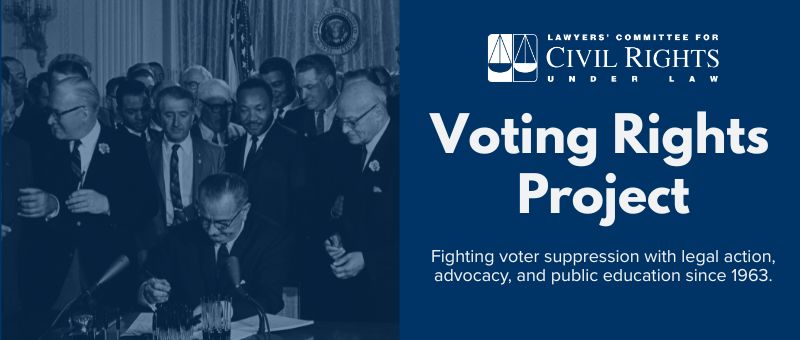
Since 1963, the Lawyers’ Committee for Civil Rights Under Law has been on the frontlines of the fight to protect and expand the right to vote. Through litigation, advocacy, voter protection, and public education, our Voting Rights Project has worked to ensure ballot access for communities of color, low-income voters, young people, people with disabilities, and other historically marginalized groups.
But today, voting rights are under the greatest threat since the passage of the Voting Rights Act in 1965. Hostile courts have gutted key protections. States across the country have passed voter suppression laws. Politicians have drawn rigged electoral maps to entrench their own power. And instead of safeguarding the vote, the federal government has too often become its adversary.
In this critical moment, we are rising to meet the challenge. We’re using every legal tool available—Section 2 of the Voting Rights Act, the National Voter Registration Act, and the 14th and 15th Amendments—to defend voters and hold power accountable. We will not back down. We remain a steadfast force against those who seek to silence voices and undermine democracy.
Join us in the fight for fair, free, and accessible elections—for everyone.
Latest Litigation Updates
Texas State Conference of the NAACP v. Abbott, No. 1:21-cv-01006 (W.D. Tex.).
This matter was filed on November 5, 2021, consolidated under League of United Latin American Citizens v. Abbott, El Paso Div. Case no. 3:21-00259-DCG-JES-JVB, which originally consolidated eight cases brought by different parties, each of whom challenges different aspects of Texas’s congressional and legislative maps under Section 2 of the Voting Rights Act and/or the U.S. Constitution. Two of the original eight Plaintiffs groups voluntarily dismissed their cases. The parties had a three-week trial from May 21-June 11, 2025, in which the Court heard testimony from multiple expert and lay witnesses on behalf of the Texas NAACP. While the parties were preparing their proposed findings of fact and conclusions of law, the Texas Legislature in Special Session began consideration of a new Congressional redistricting plan on July 21, 2025. The new plan responded to explicit instructions from the U.S. Department of Justice–based on a plainly improper reading of the law–to modify four majority-minority Congressional districts, based on their racial composition. The Governor pledged to “remove” “coalition” districts, where two or more minority groups combined to form a majority, and legislators echoed that commitment. They then carried out DOJ’s and the Governor’s instructions, enacting a new Congressional plan on August 21, 2025 that reduced the opportunities for people of color to adopt their preferred candidates in at least three districts. The Texas NAACP, along with other plaintiffs, sought a preliminary injunction against the redistricting, and the Lawyers’ Committee participated in a hearing before the U.S. District Court for the Western District of Texas from October 1 through October 10. In addition to providing direct evidence of discriminatory intent, the Lawyers Committee showed that the racial composition of the affected districts could not be explained away as merely seeking partisan gain. The Court now is now considering the motion for a preliminary injunction. .
League of Women Voters of Louisiana v. Landry, No. 3:25-cv-00413-JWD-SDJ (M.D. La.).
In May 2025, the Lawyers’ Committee filed a lawsuit challenging Louisiana’s newly enacted Senate Bill 436 (S.B. 436), a law that imposes proof-of-citizenship requirements for voter registration. The law mandates that all voter registration applicants in Louisiana must submit “proof of United States citizenship” with their application but offers no clear guidance as to what qualifies as acceptable documentation. This ambiguity not only invites inconsistent and unlawful enforcement but also threatens to deter eligible voters from registering altogether, particularly among marginalized and vulnerable populations. Even though there is no credible evidence of a problem with noncitizen voting, S.B. 436 imposes unnecessary and vague burdens on prospective voters and the individuals who assist them with registration. It will disenfranchise many eligible voters who do not have the required documentation readily available.
The lawsuit argues that the statute violates the First and Fourteenth Amendments of the U.S. Constitution, as well as the National Voter Registration Act of 1993 (NVRA). If enforced, S.B. 436 would create unlawful barriers to the ballot box and undermine the uniform federal standards designed to ensure broad access to the democratic process.
Beaumont Chapter of the NAACP v. Jefferson Co., Texas, No. 22 Civ. 488 (E.D. Tx.).
In November 2022, the Lawyers’ Committee for Civil Rights Under Law filed emergency voting rights litigation on behalf of the Beaumont Branch of the NAACP and an individual Texas voter due to egregious voter intimidation at a historically Black polling location. The Lawyers’ Committee, which operates a nonpartisan Election Protection hotline, 866-OUR-VOTE, received multiple complaints about white poll workers at the Beaumont polling place asking Black voters to loudly recite their addresses after already being checked in and verified to vote, in a gross instance of invasion of privacy and voter intimidation. After an emergency hearing, the federal court prohibited all election judges, clerks, workers, volunteers, or watchers at the John Paul Davis Community Center from requesting voters to publicly recite their addresses before allowing them to vote, positioning themselves where they can view voters’ selections, refusing to assist with scanning ballots, or otherwise turning away voters who are duly eligible to vote.
Georgia State Conference of NAACP, et al v. Raffensperger, N.D. GA. No. 1:21-cv-1259-JPB.
This matter was originally filed on March 28, 2021, amended on May 28, 2021, and amended again on January 19, 2024. This matter was subsequently consolidated with other related actions as part of In re SB 202, N.D. of GA No.1:21-mi-55555-JPB. The Plaintiffs represented by the Lawyers’ Committee, its pro bono, and local counsel, are the Georgia State Conference of the NAACP, Georgia Coalition for People’s Agenda, League of Women Voters of Georgia, GALEO Latino Community Development Fund, Common Cause, and Lower Muskogee Creek Tribe. This action challenges Georgia’s law that cut-back on several ways to vote in Georgia in the wake of the 2020 election. Prior to the November 2024 elections, Plaintiffs won two motions for preliminary injunction, enjoining (1) the requirement that absentee ballots include a correct birthdate on the return envelope, and (2) the ban on the provision of “line relief” (e.g., providing food and water to voters in line to vote) more than 150 feet from the outer edge of a polling place but within 25 feet of any voter standing in line. Appeals of each of these preliminary injunction orders are currently pending in the 11th Circuit. A cross-appeal was filed by appellees arguing that the state defendants lack standing to appeal from the preliminary injunction challenging the date of birth requirement on absentee ballot return envelopes because relief was only granted by the Court against county defendants. Oral argument on the appeals in the 11th Circuit occurred on r August 13, 2025. State defendants and GOP intervenors have also moved for summary judgment on all claims, and summary judgment briefing was concluded in May 2024. On January 30, 2025, state defendants and GOP intervenors successfully moved the court to reopen expert discovery related to the 2024 election cycle and to permit further briefing on their motions for summary judgment based upon the additional expert discovery. The parties are currently conducting supplemental expert discovery, followed by supplemental briefing related to the pending motions for summary judgment in the Fall of 2025.
Eternal Vigilance Action, Inc. v. Georgia, S25A0362, S25A0490 (GA Sup. Ct. 2025)
The Georgia Supreme Court upheld a lower court’s decision permanently blocking a rule that would have required hand counting of ballots at polling places before tabulation — a process widely criticized for risking delays, ballot spoliation, and voter disenfranchisement. The Georgia State Conference of the NAACP and the Georgia Coalition for the People’s Agenda, represented by the Lawyers’ Committee for Civil Rights Under Law and the American Civil Liberties Union, intervened in the case in the Fall of 2024 to protect the integrity of Georgia elections. The ruling confirms that the State Election Board exceeded its legal authority by attempting to rewrite election procedures just weeks before a major election without legislative approval and in direct contradiction of Georgia law.
The case, Eternal Vigilance Action, Inc. v. Georgia, challenged a series of last-minute rules passed by the Georgia State Election Board, including one that would have required the hand counting of ballots before securing them for tabulation — a burdensome and error-prone process with no grounding in Georgia’s election code. The ruling allows elections in Georgia to proceed under long-established, secure procedures, reinforcing voter confidence and administrative stability ahead of future election
Mississippi State Conference of the NAACP v. State Board of Election Commissioners, 3:22-cv-734 (S.D. Miss.)
This is a challenge to statewide legislative redistricting under Section 2 of the VRA and Fourteenth and Fifteenth Amendments as a racial gerrymander; co-counseling with ACLU, Mississippi Center for Justice, and Carroll Rhodes. The trial occurred in February and March 2024 before a three-judge panel. On July 2, 2024, the court ordered the creation of three new majority-Black districts: two Senate districts and one House district. Plaintiffs filed a formal objection to the proposed Senate district in DeSoto County and the House district in the Chickasaw and Monroe areas of Mississippi and provided the Court with proposed alternative districts to remedy the identified Section 2 violations. The Court entered final judgment in the case in May 2025 after adopting the Legislature’s remedial map in the Chickasaw and Monroe area and Defendants’ proposed remedial map for the DeSoto County area. The Defendants filed a notice of appeal to the U.S. Supreme Court on July 3, 2025. (The matter is directly appealable to the Supreme Court as of right.) In early September, the Defendants filed a jurisdictional statement identifying the issues to be raised. The Plaintiffs have filed a motion for summary affirmance of the decision of the three-judge district court.
Virginia Coalition for Immigrant Rights, et al., v. Beals,et al., No. 1:24-cv-01778-PTG (E.D. Va.). On October 8, 2024, the Lawyers’ Committee sued on behalf of the Virginia Coalition for Immigrant Rights and League of Women Voters of Virginia challenging Virginia’s ongoing purge of thousands of Virginia registered voters on the basis that they were identified as alleged noncitizens. African Communities Together joined the lawsuit as co-plaintiff on October 15. Co-counsel are Campaign Legal Center, Protect Democracy, and Advancement Project. The lawsuit alleged that Virginia’s purge process constituted systematic list maintenance within 90 days of a federal election and relied on outdated driver’s license information that led to the erroneous removal of naturalized citizens, in violation of the NVRA. DOJ filed suit on October 11 raising only the 90-day quiet period claim. On October 25, the District Court granted Plaintiffs’ Motion for Preliminary Injunction on the 90-day claim and ordered the 1,610 voters removed within the 90-day quiet period to be reinstated to the rolls and corrective notices be sent to them. Virginia immediately appealed and moved for an Emergency Stay, which was denied on October 27 in a unanimous ruling by a three-judge panel of the Fourth Circuit, but which was summarily granted by the Supreme Court on October 30 in an unsigned, unreasoned order with three dissents noted by Justices Sotomayor, Kagan, and Jackson. The 90-day quiet period claim is now moot, but the matter continues as to the remaining claims. In late January, the court heard arguments on the state’s motion to dismiss and we are waiting for a ruling.
Public Comments
Comment Opposing Petition to Require Proof of Citizenship for Federal Voter Registration
Date: October 20, 2025
The Lawyers’ Committee for Civil Rights Under Law submitted comments urging the U.S. Election Assistance Commission (EAC) to reject a petition by America First Legal Foundation seeking to require documentary proof of citizenship (DPOC) on the National Mail Voter Registration Form. The Lawyers’ Committee argued that such a requirement is unnecessary, unlawful, and inconsistent with decades of congressional, judicial, and EAC precedent rejecting similar efforts. The comment underscores that non-citizen voting is statistically negligible, while DPOC mandates would disenfranchise millions of eligible voters—especially Black, Latino, Indigenous, low-income, disabled, and elderly citizens who face barriers to obtaining qualifying documents. The organization called on the EAC to reaffirm its long-standing interpretation of the National Voter Registration Act and uphold accessible, nondiscriminatory voter registration for all eligible citizens.
The national, nonpartisan Election Protection coalition works year round to ensure all voters can cast a ballot freely, fairly, and securely. We empower and support voters and communities who have been historically disenfranchised and underrepresented in our democracy through national and state organizations working together to support coalition infrastructure and state led programs. Our core work includes direct voter assistance and education, advocacy, litigation, and communicating with election officials.
Made up of more than 300 local, state and national partners, Election Protection uses a wide range of tools and activities to protect, advance and defend the right to vote. including: a suite of voter helplines, thousands of volunteers assisting voters at voting locations across the country, and digital outreach tools to educate the public about changing voting laws. Throughout the election cycle we’re working tirelessly to ensure ballot access.
If you experience a problem at the polls or have any questions about voting, contact Election Protection. We can be reached in a number of ways, including:
- Calling our suite of voter helplines:
- (866) OUR-VOTE
- (888) VE-Y-VOTA (Spanish/English)
- (844) YALLA-US (Arabic/English)
- (888) API-VOTE (English, Mandarin, Cantonese, Korean, Vietnamese, Tagalog, Urdu, Hindi Bengali and Punjabi)
- Texting MYVOTE to (866) 687-8683 to get voting help from a trained volunteer
- Starting a conversation with us on Facebook Messenger at @866ourvote, and on WhatsApp
- Chatting with a live volunteer on the election protection website
Throughout the election cycle, Election Protection volunteers provide voters with information, document problems voters encounter when voting, host voter protection field programs, and work to identify and remove barriers to voting. All of our work is focused on protecting and defending the right to vote – we provide guidance and information to help all eligible citizens exercise their voting rights.